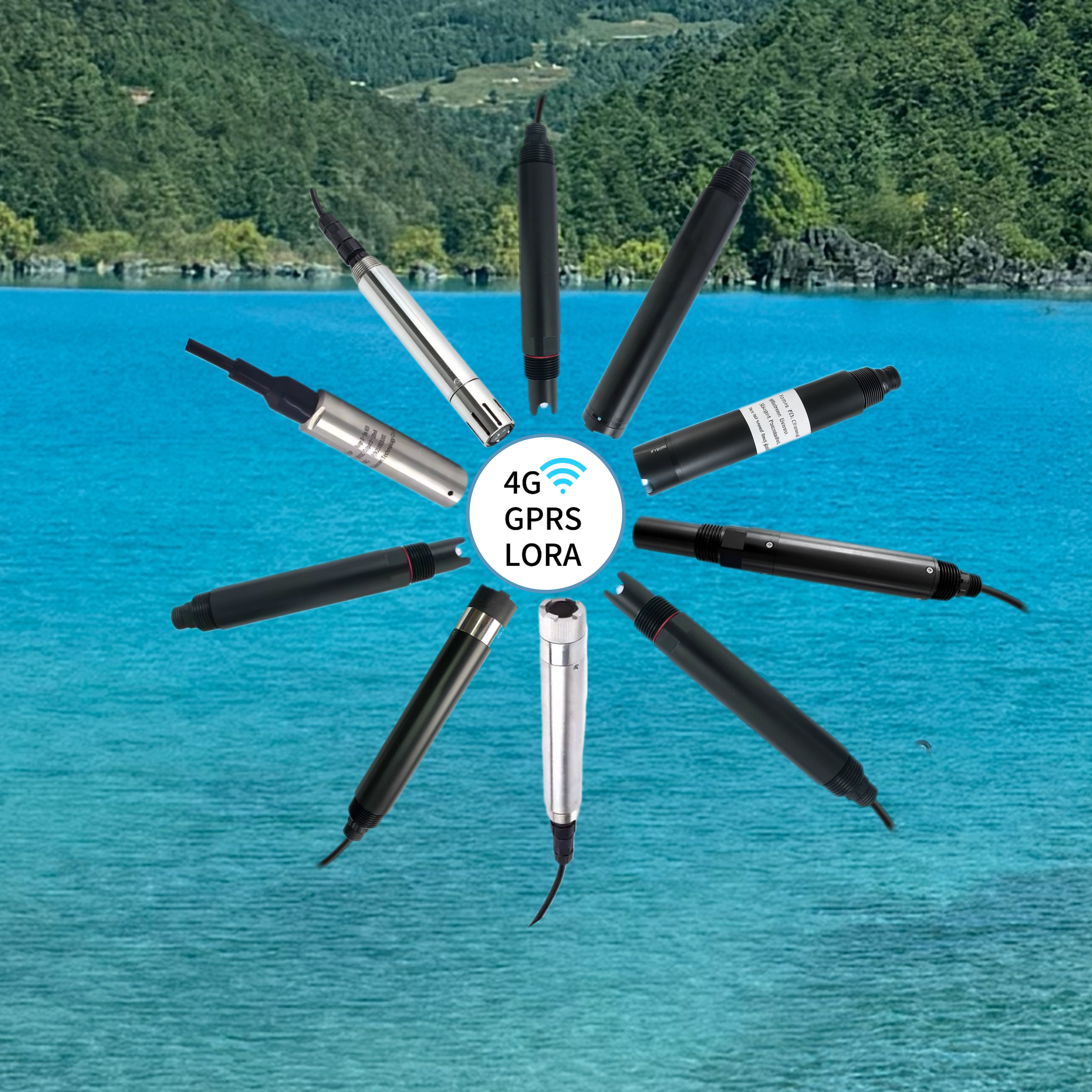
1. Definition of Online Water Quality Monitoring Sensors
An online water quality monitoring sensor is a precision analytical device that continuously detects physical and chemical parameters of water bodies in real time. It converts subtle changes in substance concentration or characteristic intensity into standard, processable electrical signals, enabling 24/7 automatic recording, display, and data analysis for water environment monitoring systems.
Simply put, the core working mechanism of online water quality monitoring sensors relies on two key capabilities: sensing and signal conversion.
Sensing: Equipped with dedicated sensitive components such as ion electrodes, permeable membranes, and optical probes, sensors trigger specific physical or chemical reactions with target substances in water samples to capture real-time water quality changes.
Signal Conversion: The subtle changes generated by reactions (including potential difference, current, light intensity, and temperature variations) are converted into standardized electrical output signals, including 4–20 mA analog current signals and digital communication signals.
As the core front-end hardware of intelligent water environment monitoring systems, online water quality monitoring sensors are widely deployed in
Aquaculture Water Quality Monitoring System, online automatic monitoring stations, water environment monitoring buoys, mobile monitoring vessels, and industrial water real-time monitoring scenarios.
2. Five Conventional Water Quality Measurement Parameters
The five conventional water quality parameters are the most fundamental and authoritative indicators for evaluating the basic state of water environments, covering physical, chemical and ecological characteristic dimensions of water bodies. The universally recognized core parameters are as follows:
Water Temperature: A fundamental correction parameter for nearly all water quality measurements. It directly affects the dissolved oxygen content in water, microbial activity, and the rate of water chemical reactions, serving as a basic reference for water environment assessment.
pH Value: A key indicator characterizing the acidity and alkalinity of water bodies. It profoundly influences the survival and reproduction of aquatic organisms, as well as the migration, transformation, and enrichment of various pollutants in water.
Dissolved Oxygen (DO): Refers to the concentration of molecular oxygen dissolved in water. It is a critical evaluation index for judging the self-purification capacity of water bodies and assessing the health status of aquatic ecological environments.
Conductivity: Indirectly reflects the total concentration of dissolved ions in water, corresponding to water salinity and total dissolved solids (TDS). It can effectively characterize the mineralization degree and inorganic pollution level of water bodies.
Turbidity: Indicates the light-blocking degree of water bodies caused by suspended sediments, algae, organic debris and other particulate matters. It is an important visual and physical indicator for evaluating water cleanliness and suspended pollution degree.
Note: The configuration of the five conventional parameters may be slightly adjusted for specific application scenarios. For individual monitoring demands, redox potential (ORP) or salinity may replace partial parameters, while the above five indicators remain the most widely adopted and industry-recognized standard configuration.
3. Classification and Principles of Optical Water Quality Sensors
Optical water quality sensors realize water quality parameter detection based on the optical interaction characteristics between water substances and light, including light absorption, scattering, fluorescence and phosphorescence. Featuring no reagent consumption, fast response speed, and strong anti-electromagnetic interference capability, they have become mainstream monitoring devices in high-precision water environment detection. The main types and applications are summarized below:
3.1 Ultraviolet-Visible (UV-Vis) Absorption Spectrum Sensors
Working Principle: According to the Beer-Lambert Law, the sensor detects the light absorption intensity of water samples at specific ultraviolet and visible wavelengths, and quantitatively calculates the concentration of target pollutants through the linear relationship between absorbance and substance concentration.
Main Applications: Real-time detection of chemical oxygen demand (COD), nitrate nitrogen (NO3-N), total organic carbon (TOC), and characteristic organic pollutants such as benzene series in water.
3.2 Fluorescence Sensors
Working Principle: Irradiate water samples with specific wavelength excitation light, and detect the intensity of long-wavelength emission light generated by the excitation of fluorescent substances in water, so as to realize quantitative monitoring of target substances.
Main Applications
• Chlorophyll-a Sensors: Estimate algal biomass and density by detecting chlorophyll fluorescence intensity in water, providing early warning for algal bloom and water eutrophication.
• CDOM/FDOM Sensors: Monitor the concentration of colored dissolved organic matter (CDOM) and fluorescent dissolved organic matter (FDOM), applied to organic pollution tracing and water ecological assessment.
• Petroleum Pollutant Sensors: Utilize the unique fluorescence characteristics of polycyclic aromatic hydrocarbons in petroleum substances to realize online monitoring of water oil spill and oil pollution.
3.3 Turbidity/Scattered Light Sensors
Working Principle: Detect the light scattering intensity generated by suspended particles in water. It mostly adopts 90° scattered light detection or 180° transmitted light detection modes to quantify water turbidity.
Main Applications: Direct and high-precision real-time measurement of water turbidity in surface water, domestic sewage and industrial wastewater.
3.4 Laser Spectrum Sensors
Working Principle: Adopt laser as the light source, which has the advantages of high monochromaticity, high brightness and low interference. Combined with Raman spectroscopy and tunable diode laser absorption spectroscopy technology, it achieves ultra-sensitive trace detection.
Main Applications: Detection of trace dissolved gases (methane, carbon dioxide, etc.) and low-concentration micro-pollutants in water, suitable for high-standard water environment fine monitoring.
4. Classification of Ion Water Quality Sensors
Ion water quality sensors are professional detection devices for specific ionic substances in water. Their core technology is based on ion-selective electrodes and advanced electrochemical sensing principles. They can accurately capture the activity and concentration of target ions in water samples, featuring simple structure, fast response and low cost, and are widely used in conventional water quality ionic index monitoring.