Rain gauges are professional instruments designed to measure precipitation in a specific area over a given period. Among the common types—including siphon, optical, weighing, and tipping bucket models—the tipping bucket rain gauge stands out as the most widely used in meteorological monitoring. Renowned for its accuracy, reliability, and ease of use, this automated device plays a crucial role in various fields, from weather forecasting to agricultural management. Below is a comprehensive breakdown of its core components, working mechanism, advantages, applications, and premium material features.
1. What Is a Tipping Bucket Rain Gauge?
A tipping bucket rain gauge is an automated weather instrument that quantifies rainfall by counting the number of times a small, balanced bucket "tips" after collecting a predefined volume of rain (typically 0.2 mm or 0.5 mm). Unlike manual rain gauges, it enables continuous, remote data collection by converting mechanical tipping motion into electrical signals, which are then recorded and analyzed. Its simple yet robust design makes it the most common choice for both professional meteorological stations and practical applications like agricultural irrigation and stormwater management.
2. Core Components
The functionality of a tipping bucket rain gauge relies on several key components, each working in tandem to ensure accurate and consistent measurements:
• Funnel: Positioned at the top of the device, the funnel collects rainwater and directs it precisely into the tipping mechanism. This component prevents water splashing and ensures all precipitation is channeled to the measuring bucket.
• Tipping Bucket: A small, balanced container pivoted at its center, usually divided into two equal chambers. Each chamber is calibrated to hold a specific volume of water (e.g., 0.2 mm of rainfall). The bucket’s balanced design is critical for triggering consistent tipping at the predefined volume.
• Pivot & Stop Sensors/Calibration Screws: The pivot allows the bucket to rotate freely when filled. Calibration screws or stop sensors limit the bucket’s rotation angle and trigger the measurement signal each time it tips. These components ensure the bucket resets accurately after each tip.
• Sensor (Reed Switch/Optical Sensor): Equipped with a magnet on the tipping bucket, the sensor (often a reed switch or optical sensor) is activated each time the bucket tips. This activation generates an electrical pulse, which serves as the basis for rainfall calculation.
• Data Logger/Recorder: The device that counts the electrical pulses sent by the sensor. Since each pulse corresponds to a known volume of rain, the data logger calculates total rainfall by multiplying the number of tips by the calibrated volume per tip. It also records rainfall duration and intensity for later analysis.
• Drainage Holes: Located at the bottom of the device, drainage holes empty the tipped bucket quickly, ensuring it is ready to collect the next batch of rainwater without residual water affecting measurements.
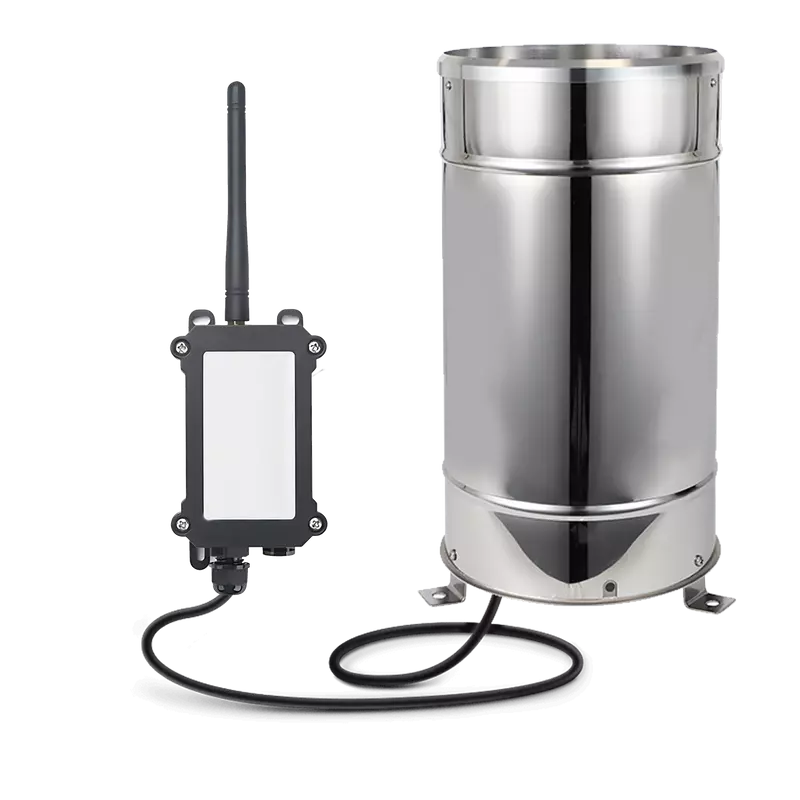
![SS2buxiugangtong-cuilianjiedian-800-800]()
Tipping Bucket Rain Gauge
3. How Does a Tipping Bucket Rain Gauge Work?
The working principle of a tipping bucket rain gauge is straightforward and efficient, following a step-by-step process:
1. Rainwater falls into the funnel at the top of the gauge, which channels the water into one of the two chambers of the tipping bucket.
2. As rain continues to accumulate, the weight of the water in the filled chamber increases until it reaches the predefined limit (e.g., the weight corresponding to 0.2 mm of rainfall).
3. Once the limit is reached, the bucket loses balance and tips around the pivot. This tipping motion causes the filled chamber to empty through the drainage holes, while the empty chamber moves into position under the funnel to start collecting water.
4. When the bucket tips, the magnet attached to it triggers the sensor (reed switch or optical sensor), generating an electrical pulse. This pulse is sent to the data logger.
5. The data logger counts each pulse and calculates total rainfall by multiplying the number of pulses by the calibrated volume per tip. It also records the timing of each pulse to determine rainfall duration and intensity.
6. The process repeats continuously as long as it rains, enabling real-time, continuous rainfall monitoring.
4. Key Advantages
The tipping bucket rain gauge’s popularity stems from its numerous practical advantages, making it suitable for a wide range of applications:
• Automated & Remote Monitoring Capability: As an automated device, it eliminates the need for manual reading, enabling 24/7 continuous data collection. This makes it ideal for remote locations such as mountainous areas, rural farmlands, or uninhabited regions where manual monitoring is impractical.
• High Accuracy & Consistency: Calibrated to measure specific rainfall volumes (0.2 mm or 0.5 mm), the device delivers precise and consistent results. Premium models often feature sapphire pivots or high-precision calibration screws to enhance durability and measurement accuracy.
• Low Maintenance Requirements: Modern designs incorporate debris filters to prevent clogging by leaves, dust, or other particles. Durable materials and simple mechanical structure reduce wear and tear, minimizing the need for frequent maintenance.
• Easy to Use & Install: Its simple design ensures straightforward installation and operation. Even non-professional users can set up and use the device with minimal training, making it accessible for both commercial and personal use.
5. Applications
The tipping bucket rain gauge’s versatility makes it indispensable in various industries and fields:
• Meteorology & Hydrology: Widely used in national meteorological stations and hydrological monitoring networks to collect long-term rainfall data. This data is critical for weather forecasting, climate change research, and water resource assessment.
• Agriculture: Farmers rely on it to monitor rainfall patterns, enabling informed decisions on irrigation scheduling, crop planting, and pest control. Accurate rainfall data helps optimize water usage and improve crop yields.
• Stormwater Management: Urban planners and environmental engineers use it to track rainfall intensity and duration, supporting the design of stormwater drainage systems and flood prevention measures. It helps mitigate the risk of urban flooding by providing real-time rainfall data.
• Environmental Monitoring: Used in ecological reserves, construction sites, and mining areas to monitor the impact of rainfall on the environment. It aids in assessing soil erosion risks and protecting sensitive ecosystems.
6. Premium Material: Stainless Steel Tipping Bucket Rain Gauges
While many tipping bucket rain gauges use stainless steel for specific parts, high-quality models (such as Renke stainless steel tipping bucket rain gauges) feature full stainless steel construction—including the tube wall, tipping bucket, funnel, and water outlet. Stainless steel offers several key benefits:
• Corrosion Resistance: Stainless steel resists corrosion from air, moisture, and chemical pollutants, making it suitable for long-term outdoor use in harsh environments (e.g., coastal areas with salt spray or industrial regions with acidic rain).
• Temperature Resistance: It can withstand extreme high and low temperatures, ensuring stable performance in diverse climates, from hot deserts to cold mountainous regions.
• Durability & Longevity: Stainless steel is resistant to aging, wear, and deformation, significantly extending the device’s service life compared to plastic or ordinary metal models.
• Compliance with Standards: Premium stainless steel models (e.g., with a 200mm inner diameter rain-bearing mouth and a 40°~45° blade-shaped edge) meet national and international meteorological standards, further ensuring measurement accuracy. They often offer multiple resolutions (0.2 mm or 0.5 mm) and signal output options (485 signal or pulse type) to adapt to different monitoring needs.
Conclusion
The tipping bucket rain gauge is a cornerstone of modern rainfall monitoring, combining simplicity, accuracy, and automation to deliver reliable data across diverse applications. Its core components work seamlessly to convert rainfall into measurable electrical signals, enabling continuous remote monitoring. With advantages like low maintenance and wide adaptability, it serves as an essential tool for meteorologists, farmers, urban planners, and environmental researchers. Premium stainless steel models further enhance its durability and performance, making it suitable for harsh outdoor environments. Whether for professional meteorological research or practical agricultural management, the tipping bucket rain gauge remains the most trusted choice for precise rainfall measurement.