1. Introduction to Plant Soil Moisture Sensors
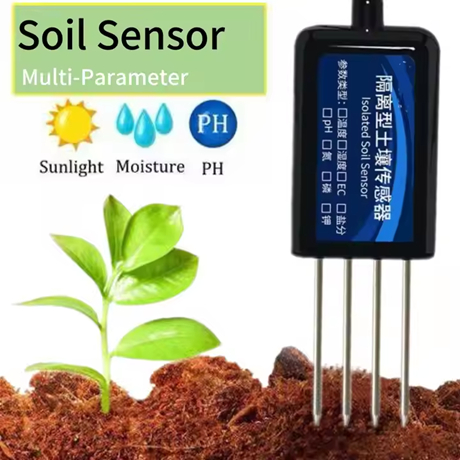
A plant soil moisture sensor is a device typically designed as a probe to measure soil water content, providing data support for irrigation decisions. It eliminates the guesswork in manual watering, effectively preventing overwatering or underwatering, and is widely used in agriculture, horticulture, landscape maintenance, and scientific research. From simple color-changing indicators to smart digital devices with wireless connectivity, these sensors vary in form but share the core function of indirectly measuring soil moisture through physical properties such as electrical resistance or dielectric constant.
The key to selecting and using a plant soil moisture sensor lies in understanding two core measurement indicators of soil moisture: soil water content and soil water potential, which are often confused but have distinct connotations.
1.1 Core Measurement Indicators
Soil Water Content (Volumetric Water Content, VWC): Refers to the volume or weight percentage of water in the soil. For example, 25% VWC means water accounts for 1/4 of the soil volume. It is the mostcommonly used indicator in practical irrigation, as it directly reflects the amount of water available for plant roots. All in-situ plant soil moisture sensors for irrigation focus on VWC measurement.
Soil Water Potential: Also known as soil suction, it reflects the energy state of soil water, i.e., the force required for plants to absorb water from the soil. Dry soil has high negative potential (making water absorption difficult), while wet soil has low potential (facilitating water absorption). This indicator is more applicable to scientific research on plant water stress and is less used in daily irrigation management.
![plant soil moisture sensor]()
plant soil moisture sensor
2. Mainstream Sensing Technologies: Principles and Comparisons
Plant soil moisture sensors indirectly measure water content by detecting changes in soil physical properties. The mainstream technologies include resistance-based, dielectric permittivity-based (TDR, FDR, capacitance), neutron probe, and others. Each technology has unique characteristics, and their performance varies significantly in accuracy, applicability, and ease of use.
2.1 Resistance Sensors
Working Principle: Two electrodes create a voltage difference, allowing a small current to flow through the soil. Since pure water is a poor conductor, current is mainly carried by ions in the soil. The resistance decreases as soil moisture increases, and the sensor converts resistance changes into moisture readings.
Pros: Extremely low cost, simple structure, easy integration into DIY projects, and low power consumption.
Cons: Poor accuracy—calibration varies with soil type and salinity. Fertilizers or soil ion changes can alter current flow even with constant moisture, leading to large errors. Sensors are prone to corrosion and degradation over time.
Suitable Scenarios: Home gardening, science fair projects, or basic wet-dry alerts where high accuracy is not required.
2.2 Dielectric Permittivity Sensors (TDR, FDR, Capacitance)
This is the most widely used technology in high-quality plant soil moisture sensors, measuring soil dielectric constant (charge storage capacity). Water has a much higher dielectric constant (≈80) than soil minerals (3–6) or air (1), so changes in soil moisture directly affect the dielectric constant, which is then converted into VWC readings.
2.2.1 Key Types
TDR (Time-Domain Reflectometry) Sensors: Transmit high-frequency electrical pulses along a probe. The travel time of the reflected pulse correlates with the soil dielectric constant, enabling VWC calculation. TDR uses a range of frequencies, reducing salinity interference.
FDR (Frequency-Domain Reflectometry) Sensors: Treat soil as a capacitor and measure the resonant frequency of the circuit. The resonant frequency changes with the dielectric constant, which is linked to soil moisture.
Capacitance Sensors: Use soil as the dielectric layer of a capacitor. Changes in soil moisture alter the capacitance, which is converted into VWC data. High-frequency capacitance sensors (≥50 MHz) can effectively avoid salinity interference.
2.2.2 Pros
High accuracy (±2–3% with calibration), low sensitivity to soil salinity (at high frequencies), low power consumption (suitable for IoT systems), easy installation, and reliable performance in scientific research and commercial applications.
2.2.3 Cons
Higher cost than resistance sensors. Low-quality low-frequency models may be affected by high soil salinity (above 8 dS/m saturation extract).
Suitable Scenarios: Commercial agriculture, landscape irrigation, scientific research, and smart irrigation systems requiring precise data.
2.3 Neutron Probes
Working Principle: Emit fast neutrons; hydrogen atoms in water slow down the neutrons. The number of slow neutrons is correlated with soil moisture.
Pros: Large measurement volume, insensitivity to salinity, and long-standing recognition in scientific research.
Cons: High cost, requires radiation operation certification, no continuous measurement, and potential radiation leakage risks.
Suitable Scenarios: Existing research projects with certification, or measurements in highly saline soils where sensor-soil contact is challenging.
2.4 Technology Comparison Summary
Technology Type | Accuracy | Cost | Power Consumption | Salinity Sensitivity | Suitable Scenarios |
Resistance | Low | Lowest | Low | Extreme | Home gardening, basic alerts |
Dielectric Permittivity (TDR/FDR/Capacitance) | High | Low-Moderate | Low | Low (High Frequency) | Commercial agriculture, smart irrigation, research |
Neutron Probe | Moderate | High | N/A | None | Certified research projects, high-salinity soils |
3. Classification of Plant Soil Moisture Sensors by Application Scenarios
Based on structural complexity and functional characteristics, plant soil moisture sensors can be divided into four categories, catering to different user needs from home gardening to professional agriculture.
3.1 Simple Indicator Sensors
Typified by devices like Sustee, they use color change to indicate moisture levels (e.g., blue to white as soil dries). No power supply is required; simply insert the probe into the soil for 60 seconds to get a "too dry," "moist," or "wet" reading. Advantages: low cost, easy to use, suitable for home gardeners and amateur plant lovers. Disadvantages: low accuracy, no quantitative data.
3.2 Resistive Sensors
Equipped with two metal probes; wet soil reduces electrical resistance to signal moisture. Advantages: low cost and simple structure. Disadvantages: prone to corrosion, affected by fertilizers, and low accuracy, suitable for basic irrigation reminders in home gardens.
3.3 Capacitive Sensors
Use special materials to measure changes in soil dielectric permittivity caused by water absorption. Advantages: high durability, low corrosion risk, and higher accuracy than resistive sensors. Suitable for small-scale agricultural plots and landscape maintenance.
3.4 Smart Digital Sensors
Integrate dielectric permittivity technology with IoT functions, supporting wireless connectivity (Bluetooth, Zigbee) to mobile apps. They can provide real-time quantitative VWC data, as well as additional metrics like soil temperature and light intensity. Some models support integration with smart home platforms (e.g., Home Assistant) to realize automated irrigation. Advantages: high accuracy, real-time monitoring, and intelligent control. Disadvantages: relatively high cost, suitable for commercial agriculture, large-scale landscapes, and scientific research.
4. Practical Applications of Plant Soil Moisture Sensors
Plant soil moisture sensors play a crucial role in improving irrigation efficiency, reducing water waste, and promoting scientific plant care. Their main application scenarios include agricultural irrigation, landscape maintenance, and scientific research.
4.1 Agricultural Irrigation
In farmland, sensors are buried in the crop root zone to monitor moisture in real time. By connecting to irrigation controllers, they trigger irrigation when soil moisture drops below a threshold and stop it when the target moisture is reached. This precise irrigation method reduces water usage by 30–50% compared to traditional methods, while improving crop yields and quality by avoiding water stress during critical growth stages.
4.2 Landscape Irrigation
In urban and suburban landscapes (residential lawns, golf courses), sensors are connected to irrigation controllers to convert ordinary timers into "smart" systems. They bypass scheduled irrigation when soil is already wet (e.g., after rainfall), preventing overwatering and leaching of fertilizers into the ground. For golf courses, this not only saves water but also maintains consistent turf quality.
4.3 Scientific Research
In agricultural science, horticulture, and environmental science, sensors are used in irrigation planning, climate change research, solute transport studies, and soil respiration measurement auxiliary systems. High-precision dielectric permittivity sensors (TDR/FDR) are widely used in field experiments to provide reliable data for scientific conclusions.
5. Operation Guidelines for Plant Soil Moisture Sensors
Proper installation, calibration, and use are key to ensuring sensor accuracy and reliability. The following guidelines apply to most common sensor types.
5.1 Installation Tips
• Root Zone Placement: Insert the probe into the plant root zone (3 inches deep for turfgrass, 6–12 inches for crops) to measure the water available to plants directly.
• Representative Soil: Install in soil typical of the target area, avoiding compacted, rocky, or sandy patches that do not reflect overall conditions.
• No Air Gaps: Ensure tight contact between the probe and soil. Air gaps from poor installation cause inaccurate readings; use a borehole tool for perpendicular insertion even in hard soil.
• Distance Requirements: Keep at least 5 feet from irrigation heads, homes, or driveways; 3 feet from planted beds; avoid traffic areas to prevent soil compaction.
• Zone-Specific Installation: For large or varied landscapes (e.g., lawns + vegetable gardens), use one sensor per zone to meet different plant water needs.
5.2 Calibration Methods
Calibration ensures sensor readings match actual soil moisture. Automatic site-specific calibration is recommended:
1. Saturate the Soil: After installation, apply 5+ gallons of water over the probe to fully saturate the soil (establishing field capacity).
2. Wait 24 Hours: Avoid watering or rainfall to allow excess water to drain, leaving soil at field capacity.
3. Initiate Calibration: Use a controller or supporting app to start auto-calibration. The sensor will set thresholds based on field capacity (typically 50–75%, adjustable).
4. Post-Establishment Calibration: For new lawns or crops, calibrate after 30–60 days (establishment period) as root depth and soil conditions change.
5.3 Basic Usage Steps
1. Insert the probe into the soil near the plant roots, ensuring the sensing part is fully buried.
2. Check readings: For simple sensors, observe color changes; for digital/smart sensors, view real-time data via the app or display.
3. Irrigate based on readings: Water when the sensor indicates "dry" (below the threshold), following plant-specific water needs.
4. Regular Maintenance: Clean the probe periodically to remove soil residues and check for corrosion, ensuring long-term accuracy.
6. Conclusion
Plant soil moisture sensors are essential tools for precise water management in modern agriculture and horticulture. By understanding core measurement indicators, selecting appropriate sensing technologies (dielectric permittivity-based sensors are recommended for most professional scenarios), and following scientific installation and calibration guidelines, users can effectively reduce water waste, improve plant health, and achieve sustainable irrigation. From simple color-changing indicators for home use to smart IoT sensors for commercial agriculture, there is a sensor type to meet every need. The future of plant soil moisture sensing lies in deeper integration with IoT and big data, further enhancing irrigation efficiency and promoting the development of precision agriculture.