1. Classification of Soil Moisture Monitoring Technologies
Soil moisture monitoring technologies can be divided into three categories according to monitoring scale and principle: ground-based point measurement technology, proximal sensing technology, and remote sensing monitoring technology. Each of the three technologies has its own focus, covering the full range of application needs from local point measurement to global scale monitoring.
(1) Ground-Based Point Measurement Technology
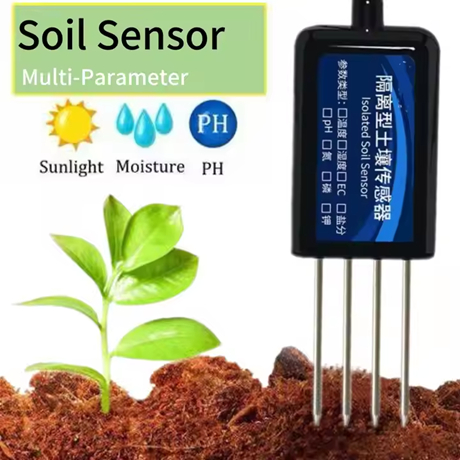
Ground-based point measurement technology is centered on direct contact soil sensor measurement, which can realize continuous or fixed-point soil moisture data collection and is the basic means of soil moisture monitoring. It mainly includes resistance probes, Time Domain Reflectometry (TDR), capacitance sensors, neutron probes and other types. Different sensors vary significantly in accuracy, cost, and applicable scenarios.
(2) Proximal Sensing Technology
Proximal sensing technology is mainly applied at the field or watershed scale. It obtains the spatial distribution characteristics of soil moisture through non-invasive means, making up for the local limitation of ground-based point measurement. Common technologies include Electromagnetic Induction (EMI), Ground-Penetrating Radar (GPR), Cosmic Ray Neutron Probe (CRNP), etc. Among them, CRNP technology can realize non-invasive measurement of regional average soil moisture over a large area, and has become a key bridge connecting ground-based point measurement and satellite remote sensing.
(3) Remote Sensing Monitoring Technology
Remote sensing technology realizes dynamic monitoring of large-scale (regional to global) soil moisture through platforms such as satellites and aircraft. According to remote sensing bands, it can be divided into optical remote sensing, thermal infrared remote sensing and microwave remote sensing. Among them, microwave remote sensing has become the mainstream technology for large-scale soil moisture monitoring due to its low sensitivity to weather conditions and ability to penetrate vegetation and surface soil. It can be further divided into active microwave remote sensing (such as Synthetic Aperture Radar, SAR) and passive microwave remote sensing (such as radiometer).
2. Principles and Performance Comparison of Main Monitoring Technologies
(1) Performance Comparison of Ground-Based Point Measurement Sensors
Sensor Type | Advantages | Disadvantages | Applicable Scenarios | Accuracy Index |
Resistance Probe | 1. Can be combined with data loggers for continuous measurement; 2. Lowest price; 3. Low power consumption | 1. Poor accuracy, calibration value varies with soil type and salt content; 2. Sensors are prone to aging | Scenarios that only need to judge changes in moisture content and have low requirements for accuracy | Low Accuracy |
TDR Probe | 1. Can perform continuous measurement; 2. High accuracy (2-3%) after soil-specific calibration; 3. Insensitive to salinity (until signal disappears); 4. High academic recognition | 1. Higher operational complexity than capacitance sensors; 2. Installation requires trenching, which is time-consuming; 3. Invalid in high-salinity environments; 4. High power consumption (requires large rechargeable batteries) | Laboratories equipped with relevant systems that require high-precision measurement | High Accuracy (2-3%) |
Capacitance Sensor | 1. Can perform continuous measurement; 2. Easy installation for some types; 3. High accuracy (2-3%) after calibration; 4. Low power consumption (small batteries are sufficient); 5. Low price, enabling multi-point measurement | 1. Accuracy decreases in high-salinity environments (saturated extract electrical conductivity > 8 dS/m); 2. Poor performance of low-quality brands | Scenarios requiring multi-point measurement, simple system deployment and maintenance, and low power consumption | High Accuracy (2-3%) |
Neutron Probe | 1. Large measurement volume; 2. Insensitive to salinity; 3. High academic recognition (mature technology); 4. Not affected by soil-sensor contact issues | 1. Expensive; 2. Operation requires radiation certification; 3. Extremely time-consuming; 4. Cannot perform continuous measurement | Scenarios with existing equipment and certification that require measurement of high-salinity or expansive-shrinking clay soils | Low Accuracy (improved after field calibration) |
CRNP (Cosmic Ray Neutron Probe) | 1. Extremely large measurement range (influence volume with 800m diameter); 2. Automatic measurement; 3. Suitable for ground validation of satellite data (smoothing large-scale variability); 4. Not affected by soil-sensor contact issues | 1. Highest price; 2. Unclear measurement volume definition, varying with soil moisture; 3. Accuracy limited by confounding factors such as vegetation | Scenarios requiring large-scale average moisture values and ground validation of satellite data | RMSE ≈ 0.032 cm³/cm³ (after calibration) |
Sensor Type | Advantages | Disadvantages | Applicable Scenarios | Accuracy Index |
Resistance Probe | 1. Can be combined with data loggers for continuous measurement; 2. Lowest price; 3. Low power consumption | 1. Poor accuracy, calibration value varies with soil type and salt content; 2. Sensors are prone to aging | Scenarios that only need to judge changes in moisture content and have low requirements for accuracy | Low Accuracy |
TDR Probe | 1. Can perform continuous measurement; 2. High accuracy (2-3%) after soil-specific calibration; 3. Insensitive to salinity (until signal disappears); 4. High academic recognition | 1. Higher operational complexity than capacitance sensors; 2. Installation requires trenching, which is time-consuming; 3. Invalid in high-salinity environments; 4. High power consumption (requires large rechargeable batteries) | Laboratories equipped with relevant systems that require high-precision measurement | High Accuracy (2-3%) |
Capacitance Sensor | 1. Can perform continuous measurement; 2. Easy installation for some types; 3. High accuracy (2-3%) after calibration; 4. Low power consumption (small batteries are sufficient); 5. Low price, enabling multi-point measurement | 1. Accuracy decreases in high-salinity environments (saturated extract electrical conductivity > 8 dS/m); 2. Poor performance of low-quality brands | Scenarios requiring multi-point measurement, simple system deployment and maintenance, and low power consumption | High Accuracy (2-3%) |
Neutron Probe | 1. Large measurement volume; 2. Insensitive to salinity; 3. High academic recognition (mature technology); 4. Not affected by soil-sensor contact issues | 1. Expensive; 2. Operation requires radiation certification; 3. Extremely time-consuming; 4. Cannot perform continuous measurement | Scenarios with existing equipment and certification that require measurement of high-salinity or expansive-shrinking clay soils | Low Accuracy (improved after field calibration) |
CRNP (Cosmic Ray Neutron Probe) | 1. Extremely large measurement range (influence volume with 800m diameter); 2. Automatic measurement; 3. Suitable for ground validation of satellite data (smoothing large-scale variability); 4. Not affected by soil-sensor contact issues | 1. Highest price; 2. Unclear measurement volume definition, varying with soil moisture; 3. Accuracy limited by confounding factors such as vegetation | Scenarios requiring large-scale average moisture values and ground validation of satellite data | RMSE ≈ 0.032 cm³/cm³ (after calibration) |
(2) Core Principles and Performance of Remote Sensing Monitoring Technologies
Remote sensing monitoring technology retrieves soil moisture by detecting the reflection, emission or scattering characteristics of soil to electromagnetic radiation in different bands. The measurement depth, spatial resolution and applicable scenarios of technologies in different bands vary significantly:
• Optical and Thermal Infrared Remote Sensing: Optical remote sensing (visible light, near-infrared, short-wave infrared) retrieves soil moisture in the extremely thin surface layer (≤1mm) through changes in soil color (moist soil is darker); thermal infrared remote sensing indirectly reflects moisture conditions by monitoring changes in surface soil temperature. Both are susceptible to weather and vegetation cover and have shallow measurement depth.
• Microwave Remote Sensing: Retrieves moisture by measuring the volumetric dielectric constant of soil (the dielectric constant of water is about 80, much higher than that of soil solids and air), which is divided into active (radar transmits signals to measure echoes) and passive (measures natural microwave radiation) types. Among microwave bands, L-band and P-band have strong ability to penetrate vegetation and are suitable for monitoring near-surface and root zone soil moisture; C-band is suitable for bare soil or sparsely vegetated areas.
Performance Comparison of Mainstream Microwave Remote Sensing Satellite Missions
Satellite Mission | Sensor Type | Band | Spatial Resolution | Revisit Period | Core Advantages | Accuracy Index |
SMOS (Soil Moisture and Ocean Salinity Satellite) | Passive Microwave Radiometer | L-band | 25 km (EASE-2 Grid) | 3 days | The first satellite mission specifically for monitoring soil moisture, capable of retrieving Vegetation Optical Depth (VOD) | Median R²=0.75, RMSE=0.023 m³/m³ |
SMAP (Soil Moisture Active Passive Satellite) | Active Radar + Passive Radiometer (Radar failed) | L-band | 36 km (Standard), 9 km (Enhanced) | 2-3 days | Currently the most accurate global soil moisture product, capable of providing root zone (0-100cm) moisture data | ubRMSE=0.035-0.038 cm³/cm³ (surface layer); 0.026-0.03 cm³/cm³ (root zone) |
Sentinel-1 | Active Synthetic Aperture Radar (SAR) | C-band | 10-20 m | 6 days | High spatial resolution, can be fused with SMAP data to generate 3km resolution products | RMSE<0.046 cm³/cm³ |
ESA CCI (Climate Change Initiative) | Active + Passive Microwave Fusion | Multi-band | Multiple Resolutions | Depends on data source | Provides long-term continuous global soil moisture data since 1978 | Medium comprehensive accuracy, suitable for long-term climate change research |
3. Key Factors Affecting Soil Moisture Monitoring Accuracy
Based on the meta-analysis results of Literature 3, the accuracy of soil moisture monitoring is affected by various factors such as sensor type, modeling method, and environmental conditions. The core influencing factors are as follows:
(1) Sensor and Technical Configuration
• Sensor Type: The accuracy of active and passive microwave sensors is comparable when used alone (median R²=0.7 for both), but there are few studies on their combined use. Current evidence shows that the fusion accuracy has not been significantly improved (median R²=0.59), which requires further research and optimization.
• Polarization Mode: Among active microwave sensors, the VV+VH dual-polarization combination has the highest accuracy (median R²=0.76, RMSE=0.035 m³/m³), followed by HH polarization, and VH polarization has the lowest accuracy.
• Measurement Depth: Microwave remote sensing is mainly suitable for monitoring surface layer (0-5cm) soil moisture. Deep layer (>20cm) moisture needs to be indirectly retrieved through machine learning models. Currently, the number of data samples for deep layer monitoring accuracy is small, and the conclusion is not yet clear.
(2) Modeling and Data Processing Methods
The inversion modeling method of monitoring data significantly affects the accuracy:
• Machine Learning Models (especially neural networks) have the highest accuracy, with median R²=0.73 and RMSE=0.035 m³/m³; among them, LSTM networks have the highest accuracy (median R²=0.86) because they can capture temporal dependence.
• Semi-Empirical Models (such as Water Cloud Model (WCM), τ-ω Model) are widely used, and their accuracy is slightly lower than that of machine learning (median R²=0.71, RMSE=0.042 m³/m³).
• The combination of machine learning and semi-empirical models can further improve accuracy (median R²=0.79, RMSE=0.030 m³/m³).
(3) Environmental and Surface Conditions
• Climate Type: The monitoring accuracy in arid and semi-arid regions (with higher median R²) is better than that in humid and semi-humid regions. Because humid regions have dense vegetation and large moisture fluctuations, which are likely to interfere with signals.
• Soil Texture: Sandy loam has the highest monitoring accuracy (median R²=0.75); passive sensors perform better in clay loam and clay, while active sensors perform better in sandy loam and loam.
• Land Cover: Agricultural land (wheat, corn, soybeans, etc.) is the main research scenario. The density of vegetation affects the penetration of microwave signals, thereby affecting accuracy, but the difference in monitoring accuracy between different seasons is not significant, reflecting the stability of microwave technology.
4. Application Systems and Data Resources for Soil Moisture Monitoring
(1) Internet of Things (IoT) and Data Management Systems
The ZENTRA system proposed in Literature 1 is a typical IoT solution for soil moisture monitoring. It integrates sensors, data loggers and cloud platforms (ZENTRA Cloud) to realize simplified installation, remote data download, real-time fault early warning and multi-site data fusion. It can significantly reduce the workload of researchers and improve data management efficiency.
(2) Global and Regional Monitoring Networks
• COSMOS Network: A global soil moisture observation network based on CRNP technology. Currently, there are about 194 permanent stations around the world, covering regions such as the United States, Germany, Australia, and the United Kingdom. It can fill the spatial scale gap between ground-based point measurement and satellite remote sensing.
• International Soil Moisture Network (ISMN): Integrates in-situ soil moisture data from multiple stations around the world, covering a variety of measurement technologies, and is an important basic data resource for remote sensing data validation.
• TERENO Network: Germany's Terrestrial Environmental Observatories network, which includes 20 CRNP stations for watershed-scale soil moisture dynamic monitoring.
(3) Data Products and Sharing Platforms
• SMOS Data: Available from the ESA official website and CATDS platform, including surface soil moisture, VOD, root zone soil moisture and other products.
• SMAP Data: Released by the National Snow and Ice Data Center (NSIDC) of the United States, including surface and root zone soil moisture products with the highest accuracy.
• ESA CCI Data: Provides long-term global soil moisture data (three types of products: active, passive, and fused) since 1978, which can be obtained from the ESA Soil Moisture CCI official website.
5. Research Conclusions and Future Directions
The three literatures consistently indicate that soil moisture monitoring technologies have formed a full-scale system from ground-based point measurement to global remote sensing. Among them, microwave remote sensing is the core technology for large-scale monitoring, and machine learning models have significantly improved inversion accuracy. The core challenges of current technologies include: accuracy optimization of the fusion of active and passive microwave sensors, verification of deep soil moisture monitoring methods, and improvement of monitoring accuracy in complex vegetation and humid regions. Future research should focus on these directions, while further improving data assimilation methods, strengthening the combination of remote sensing data and ground observations, and promoting the in-depth application of soil moisture data in fields such as agricultural irrigation management, drought and flood early warning, and climate change research.