Smart agriculture is changing the way growers manage crops, greenhouses, and irrigation systems. Instead of relying only on experience or manual inspection, farmers can now collect real-time field data and make better decisions based on actual conditions.
Among the many devices used in modern farming, three sensor types are especially important: rain gauges, soil sensors, and CO₂ sensors. Together, they help growers understand water supply, soil condition, and greenhouse air quality, which are all critical for crop health and yield.
Why Sensors Matter in Smart Agriculture
In traditional farming, irrigation, fertilization, and greenhouse ventilation are often adjusted based on fixed schedules or visual observation. However, field conditions can change quickly due to weather, soil differences, and crop growth stages.
With smart agriculture sensors, growers can:
monitor farm conditions in real time
reduce water and fertilizer waste
improve crop consistency and yield
respond faster to changing weather or soil conditions
support data-driven farm management
This is why sensors have become a key part of precision agriculture and greenhouse automation. Smart agriculture uses real-time environmental and soil data to optimize crop management and improve productivity.
Rainfall is one of the most important variables in agriculture. If farmers know exactly how much rain has fallen, they can adjust irrigation schedules more accurately and avoid both overwatering and underwatering.
A tipping bucket rain gauge is widely used for this purpose. It measures natural rainfall and converts precipitation into digital signals for transmission, recording, and display. Your LoRaWAN model is designed for remote rainfall monitoring and supports LoRaWAN Class A communication, making it suitable for distributed field deployment.
Why rain gauges are useful in farming
help optimize irrigation timing
support rainfall-based water management
reduce unnecessary irrigation costs
provide precipitation records for open-field farming
support remote monitoring in large agricultural areas
For farms that need wireless deployment, a LoRaWAN rain gauge is especially useful because it can transmit rainfall data over long distances with low power consumption. The BGT product page also positions this type of sensor for agriculture, hydrology, and remote telemetry applications.
2. Soil Multi-Parameter Sensors: Understanding What Is Happening Underground
Soil is the foundation of crop growth, but many important changes happen below the surface and cannot be seen directly. That is why soil monitoring is essential in smart farming.
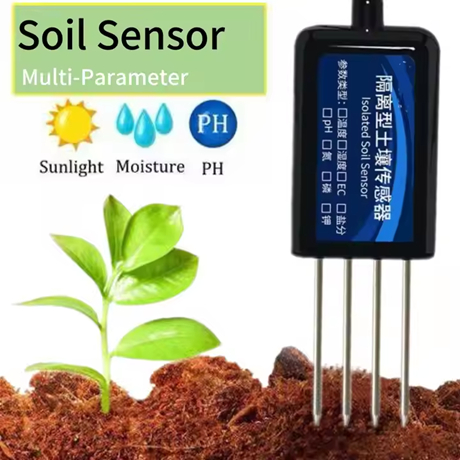
A soil multi-parameter sensor can collect several important measurements in one device. Your BGT-SMPS sensor is presented as a 7-in-1 soil analyzer that measures soil temperature, moisture, EC, pH, and NPK, with RS485/Modbus-RTU output for integration with IoT platforms. It also highlights IP68 protection and 316L stainless steel probes for harsh field environments.
What can a soil sensor help monitor?
Soil moisture
Soil moisture data helps farmers irrigate more precisely. Too little water can stress crops, while too much water may reduce root oxygen and increase disease risk.
Soil temperature
Soil temperature affects seed germination, root activity, and nutrient uptake. Monitoring it helps growers better understand crop development conditions.
Soil EC
Electrical conductivity helps indicate the level of soluble salts and fertilizer concentration in the soil. This can support fertilization management and prevent over-application.
Soil pH
Soil pH influences nutrient availability. Different crops perform best in different pH ranges, so monitoring pH helps improve soil management decisions.
NPK
Nitrogen, phosphorus, and potassium are key nutrients for crop growth. A multi-parameter sensor makes it easier to track nutrient status without relying entirely on repeated manual sampling.
Why growers choose multi-parameter soil sensors
fewer devices needed in the field
easier installation and maintenance
more complete soil data from one point
supports precision irrigation and fertilization
suitable for smart farming and IoT integration
Compared with single-function probes, a multi-parameter soil sensor provides a more complete picture of root-zone conditions, which is particularly valuable for precision agriculture projects, smart irrigation systems, and greenhouse production.
3. CO₂ Sensors: A Key Tool for Greenhouse Climate Monitoring
In greenhouse agriculture, air quality is just as important as soil and water. Carbon dioxide plays a direct role in photosynthesis, so monitoring CO₂ concentration can help growers maintain a better environment for plant growth.
Your wall-mounted CO₂ sensor uses NDIR technology with a built-in precision optical path and temperature sensor, and the page emphasizes high accuracy, good stability, temperature compensation, and no oxygen dependence. It is also described as suitable for agriculture and greenhouse use.
Why CO₂ monitoring matters in greenhouses
supports photosynthesis management
helps optimize greenhouse ventilation
improves environmental control strategies
supports healthier and more consistent crop growth
provides useful data for automated greenhouse systems
In closed or semi-closed greenhouse environments, CO₂ concentration can fluctuate significantly. By using a CO₂ sensor, growers can better coordinate ventilation, enrichment, and environmental control systems.
How These Three Sensors Work Together in Smart Agriculture
Although each sensor measures a different parameter, they are much more valuable when used together.
For example:
the rain gauge tells you how much natural rainfall the field has received
the soil sensor shows whether moisture and nutrients in the soil are sufficient
the CO₂ sensor helps manage greenhouse air conditions for plant growth
Together, these sensors help build a more complete monitoring system for smart agriculture. Instead of making decisions from a single data point, farmers can understand the interaction between weather, soil, and crop environment.
This is especially useful for:
greenhouse cultivation
precision irrigation projects
smart farming systems
agricultural IoT deployments
crop monitoring in commercial farms
How to Choose the Right Agriculture Sensors
When selecting sensors for a smart agriculture project, buyers should consider several factors:
1. Monitoring goals
Do you need rainfall monitoring, soil monitoring, greenhouse air monitoring, or all of them together?
2. Installation environment
Outdoor fields, greenhouses, orchards, and irrigation projects may require different sensor structures and protection levels.
3. Communication method
For IoT projects, output and transmission are important. For example, the rain gauge supports LoRaWAN, while the soil sensor supports RS485/Modbus-RTU.
4. Durability
Agricultural sensors often work in wet, dusty, or high-temperature environments. Products with rugged housing and stable performance are more suitable for long-term use.
5. Integration capability
If you plan to build a complete monitoring system, choose sensors that can be integrated into data loggers, gateways, IoT platforms, or farm management software.
Conclusion
Smart agriculture depends on accurate, real-time field data, and sensors are the foundation of that data collection.
Among the most practical sensor types, rain gauges, soil multi-parameter sensors, and CO₂ sensors play a major role in helping growers improve irrigation, fertilization, and greenhouse management. Whether the project is for open-field farming or protected cultivation, choosing the right combination of sensors can improve efficiency, reduce waste, and support better crop outcomes.
If you are building a smart agriculture monitoring system, starting with these three sensor categories is a practical and effective first step.