What Are Smart Agricultural Sensors?
Agriculture is no longer just about experience—it’s about data.
With increasing pressure on water resources, rising labor costs, and unpredictable weather, farmers are turning to Smart Agricultural Sensors to gain control, reduce risk, and maximize productivity.
Smart Agricultural Sensors are intelligent devices designed to monitor key environmental and soil conditions in real time. They collect critical data such as soil moisture, temperature, crop conditions, rainfall, and environmental factors.
Once connected to an IoT system, this data becomes actionable. Instead of guessing, farmers can irrigate precisely, prevent crop diseases early, and automate operations.
The result is simple: higher yields, lower costs, and better control.
The Most Important Smart Agricultural Sensors
A high-performing smart agriculture system is built on multiple sensors working together. Each one plays a key role in improving efficiency and reducing uncertainty.
Soil Moisture and Temperature Sensors: Control Your Irrigation Precisely
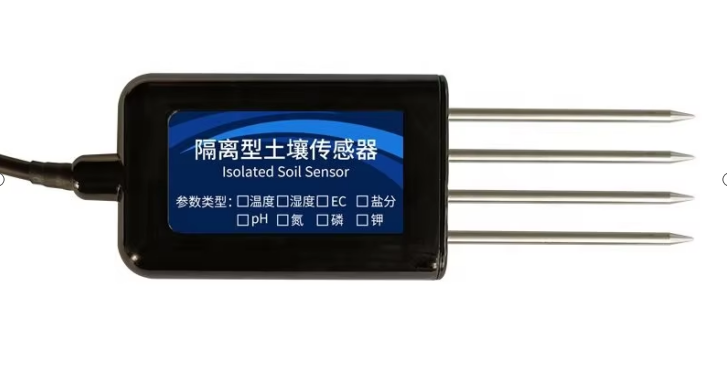
Soil sensors are the foundation of smart farming.
They continuously monitor soil moisture, temperature, and sometimes electrical conductivity (EC), providing real-time insight into root-zone conditions.
With accurate soil data, farmers can:
Avoid overwatering and save water
Prevent root damage
Improve nutrient absorption
Increase crop consistency
This allows precise irrigation decisions instead of relying on guesswork.
![1]()
Leaf Wetness Sensors: Stop Crop Diseases Before They Start
Crop diseases often develop before visible symptoms appear.
Leaf wetness sensors detect moisture on plant surfaces, helping identify conditions favorable for fungal growth.
With this data, farmers can:
Predict disease outbreaks early
Optimize pesticide application timing
Reduce chemical usage
Protect crop yield and quality
This is especially valuable for high-value crops and greenhouse environments.

Rainfall Sensors: Make Smarter Water Decisions
Rainfall is one of the most unpredictable variables in agriculture. Too little rain can stress crops and reduce yield, while excessive rainfall can lead to waterlogging, nutrient loss, and disease outbreaks.
That’s why accurate rainfall monitoring is essential for modern precision farming.
A Tipping Bucket Rain Gauge is one of the most widely used rainfall sensors in smart agriculture and environmental monitoring. It measures rainfall by collecting precipitation through a funnel and automatically converting it into digital signals for real-time monitoring and analysis.
Unlike traditional manual rain gauges, modern tipping bucket rain gauges provide continuous and automated rainfall measurement, making them ideal for remote agricultural applications.
The BGT Hydromet Tipping Bucket Rain Gauge is specifically designed for reliable long-term outdoor monitoring. Built with a stainless-steel structure and UV-resistant components, it delivers stable performance even in harsh weather conditions.
Key advantages include:
High-precision rainfall measurement with 0.2 mm resolution
Real-time precipitation monitoring
Durable stainless-steel construction for outdoor environments
Optional RS485, LoRaWAN, and 4G communication
Low maintenance design with debris protection filter
BGT Hydromet also integrates rainfall sensors into IoT monitoring systems, allowing users to access real-time rainfall data remotely through cloud platforms and telemetry networks.
With accurate rainfall data, farmers and agricultural managers can:
Avoid unnecessary irrigation
Improve water resource management
Monitor drought conditions
Prepare for heavy rainfall events
Optimize irrigation scheduling based on real weather conditions

Weather Stations: Understand Your Environment in Real Time
In modern agriculture, success depends on how well you understand your environment. Weather conditions can change rapidly, and even small variations in climate can have a direct impact on crop growth, irrigation planning, and field operations.
A weather station provides a complete, real-time overview of environmental conditions, allowing farmers to make faster and more accurate decisions.
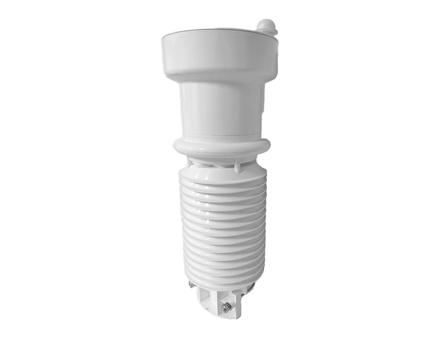
An integrated weather station typically monitors:
Temperature and humidity
Wind speed and wind direction
Atmospheric pressure
(Optional) rainfall, solar radiation, and other parameters
With this continuous stream of data, farmers can:
Plan planting and harvesting with greater confidence
Optimize spraying conditions to reduce chemical loss
Adjust irrigation strategies based on real weather patterns
Minimize risks caused by sudden climate changes
The BGT Hydromet integrated weather station is designed as a compact, all-in-one solution for agricultural and environmental monitoring. By combining multiple sensors into a single unit, it simplifies installation while ensuring consistent and accurate data collection in the field.
Key advantages include:
All-in-one compact design for easy deployment
Multi-parameter monitoring in a single device
High-precision sensors for reliable data
Support for RS485, LoRaWAN, and 4G communication
Low power consumption for remote and solar-powered applications
Unlike traditional mechanical weather stations, modern ultrasonic weather stations eliminate moving parts. This significantly reduces wear and tear, improves long-term stability, and minimizes maintenance requirements.
As a result, they are especially suitable for:
Smart agriculture systems
Greenhouse and open-field monitoring
Remote or unattended installations
Long-term environmental observation

Smart Agriculture IoT Systems: Turn Data into Action
Sensors provide data—but IoT systems turn that data into results.
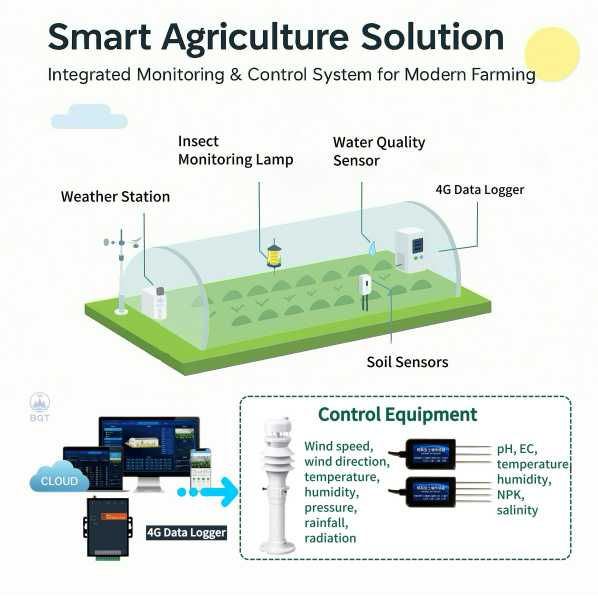
A smart agriculture IoT system connects all sensors into a unified network, enabling:
Real-time monitoring from anywhere
Automatic alerts and notifications
Data visualization dashboards
Automated irrigation and control
This allows farms to operate more efficiently with less manual intervention.
![企业微信截图_17796934342431]()
How Smart Agricultural Sensors Work Together
The real power of smart agriculture comes from integration.
A complete system includes:
Sensor Layer
Soil sensors
Leaf wetness sensors
Rain gauges
Monitoring Layer
Platform Layer
Together, they create a seamless process:
Data Collection → Analysis → Decision → Action
This transforms farming from reactive to proactive.
Why Choose BGT Hydromet
Choosing the right partner is critical for building a reliable smart agriculture system.
BGT Hydromet provides more than just sensors—it delivers complete monitoring solutions tailored to real-world agricultural needs.
Key advantages include:
High-precision, durable sensors designed for outdoor environments
Support for LoRaWAN, 4G, and other communication technologies
Integrated IoT platforms for real-time data and automation
Extensive experience in agriculture, hydrology, and environmental monitoring
BGT Hydromet focuses on system-level solutions, helping customers build scalable and future-ready smart agriculture systems.
The Future of Farming Is Data-Driven
Modern agriculture is evolving rapidly.
With increasing demand for efficiency and sustainability, farmers need smarter tools to stay competitive.
Smart Agricultural Sensors enable:
As technology advances, these systems will become even more powerful with AI-driven insights and automation.
FAQ: Smart Agricultural Sensors
What are smart agricultural sensors used for?
They are used to monitor soil, crops, and environmental conditions in real time, helping farmers optimize irrigation, prevent diseases, and improve efficiency.
Which sensor is most important in agriculture?
Soil moisture sensors are the most critical because they directly influence irrigation decisions, but a complete system requires multiple sensors.
How do smart agricultural sensors improve crop yield?
They provide accurate data that helps farmers maintain optimal growing conditions, reduce stress on crops, and make better decisions.
Are smart agricultural sensors suitable for small farms?
Yes. These systems can be scaled to fit farms of any size, from small operations to large agricultural enterprises.
Can these sensors be integrated into existing systems?
Most smart agricultural sensors support standard protocols like RS485 and can be integrated into existing monitoring systems.
Start Building Your Smart Agriculture System Today
The difference between traditional farming and smart farming is clear:
Better control. Higher efficiency. Greater profitability.
If you are looking to upgrade your farm with reliable Smart Agricultural Sensors, choosing the right solution is the first step.
BGT Hydromet can help you design a customized system tailored to your needs—from individual sensors to complete IoT agriculture solutions.
Contact us today to explore how smart agricultural technology can transform your farming operations.